• Oregon
    • Washington
    Concrete Coatings NW
    • Floor Systems
      • Polyaspartic
      • Polyurea
      • Urethane Cement Flooring
      • Floating Tiles
    • Residential
      • Basement
      • Garage
      • Patios and Walkways
      • Sport Court
    • Commercial
    • Areas We Serve
      • Portland
      • Vancouver
    • About
    • Blog
    • Contact
    • Menu Menu

    How to Choose a Slip-Resistant Concrete Coating for Your Home’s Patio and Walkways

    A slip-resistant concrete coating on a Portland patio is the baseline requirement for a surface that stays wet from October through May and can develop moss in a matter of weeks. The question most homeowners researching concrete patio coatings run into is how to tell whether a coating actually delivers safe traction or just sounds like it does on a product page.
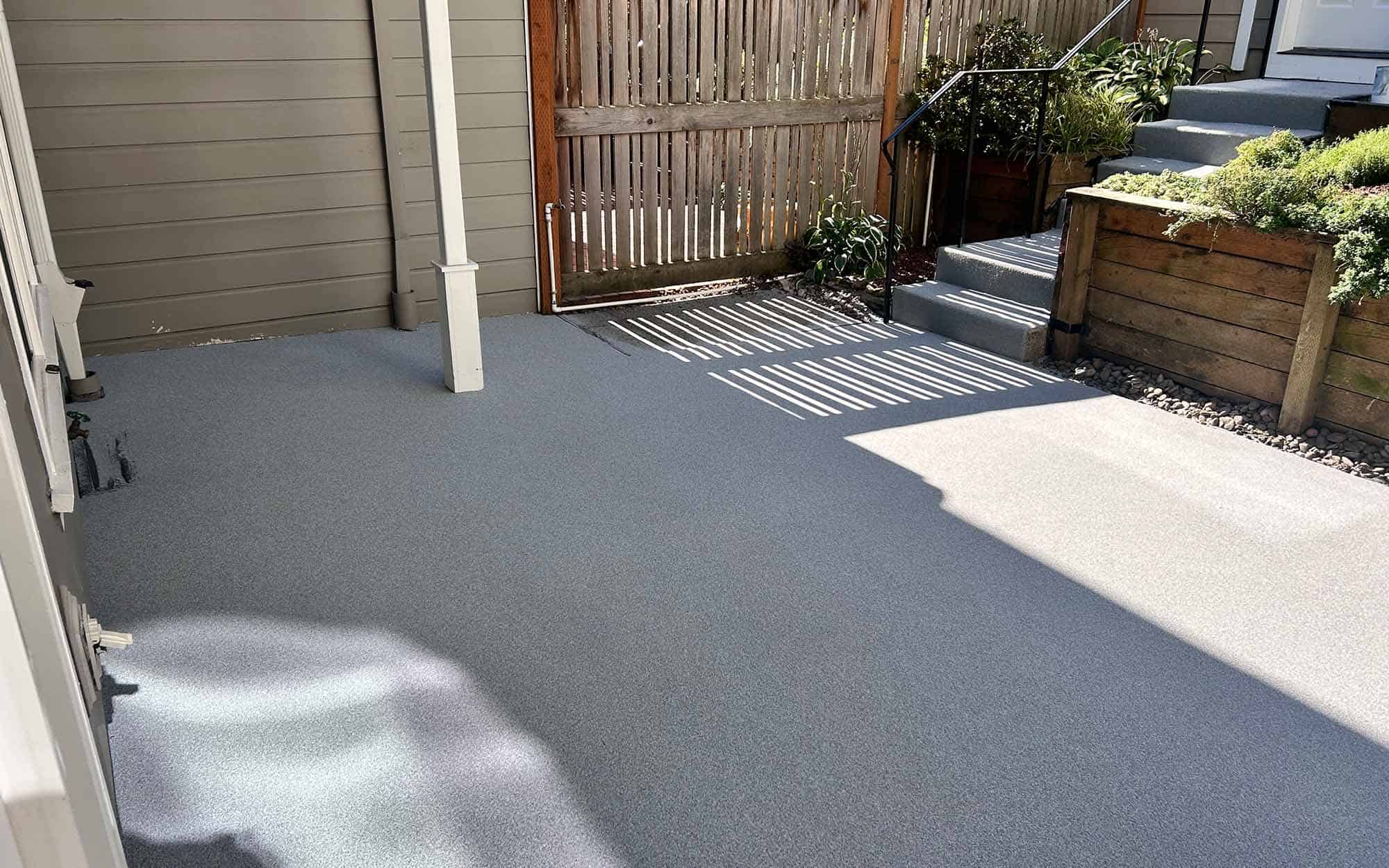
    Concrete Coatings Nw Showcase Image 6

    Why Slip Resistance Is a Different Conversation in the Pacific Northwest

    Most patio coating guides are written for climates where wet concrete is a seasonal issue. In the Portland and Vancouver area, it’s a year-round condition, and that changes what you need from any coating system you’re considering.

    What the Pacific Northwest Climate Does to Uncoated Concrete

    Bare concrete is porous, and in a wet climate it stays saturated through long stretches of rain. That moisture creates ideal conditions for moss and algae to take root across the surface, which turns an already-slippery wet patio into a genuine safety hazard. Moss on concrete holds moisture against the slab, accelerates surface breakdown, and returns quickly after cleaning because the spores are still embedded in the pores. A properly installed patio floor coating eliminates the surface porosity that allows moss to establish in the first place, giving the surface somewhere to shed water instead of absorbing it.

    What Slip Resistance Actually Means

    The industry measures traction using the Dynamic Coefficient of Friction, or DCOF. A rating of 0.42 or higher is the standard for wet pedestrian surfaces, and it’s the minimum threshold a slip-resistant concrete coating used on an outdoor patio should meet. Coatings that achieve this use either broadcast aggregates or a textured surface profile built into the coating material itself. The number on a product spec sheet tells you the rating in controlled conditions. What matters for a homeowner is how that rating holds up across years of rain, freeze-thaw cycles, and regular foot traffic.

    Understanding What Makes a Slip-Resistant Coating Hold Up

    Not every slip-resistant concrete coating achieves traction the same way, and not every approach holds up equally well on an outdoor surface exposed to Pacific Northwest weather.

    Broadcast Aggregates vs. Built-In Texture

    Broadcast aggregates are the most common approach. During installation, small particles like aluminum oxide or quartz are scattered into the wet top coat before it cures. Those particles become embedded in the surface and create consistent grip across the slab. The effectiveness depends on the density of the broadcast and the quality of the aggregate used. Urethane cement flooring systems use a trowel-applied process that creates a naturally textured surface profile, making them a reliable baseline for outdoor slip resistance even before any aggregate is added.

    Why the Base Coating Material Matters

    A slip-resistant concrete coating is only as durable as the system it’s built on. If the base coat doesn’t bond properly to the slab, or if the material is prone to cracking under outdoor temperature swings, the surface texture becomes inconsistent over time as the coating breaks down. Outdoor concrete contracts in cold temperatures and expands in summer heat, a range Portland patios can cycle through dozens of times in a single season. Flexible coating materials handle that thermal movement without cracking. Rigid ones, applied in the wrong environment, eventually fail at the bond line and take the traction surface with them.

    Your patio’s exposure, drainage, and slab condition all factor into which coating system will hold its traction over time.

    Talk to Our Team

    Urethane Cement vs. Polyaspartic for Outdoor Patios

    Both systems are installed on patios and walkways across Portland, and both can deliver a slip-resistant surface. The difference comes down to how much direct weather the slab takes.

    Why Urethane Cement Is the Default for Outdoor Applications

    Urethane cement is flexible, which means it handles the thermal movement outdoor concrete goes through without cracking at the bond line. It’s fully waterproof, UV stable, and 100% non-toxic. Concrete Coatings NW installs an NSF-61 certified system that’s safe for surfaces that contact the elements year-round. For a patio or walkway that faces direct rain exposure and freeze-thaw cycles through Pacific Northwest winters, urethane cement’s flexibility and built-in surface texture make it the most reliable long-term choice. It’s also the system used most often on pool decks, where standing water and bare feet raise the stakes further.

    When Polyaspartic Makes Sense Outdoors

    A polyaspartic patio coating is UV stable, cures fast, and holds up well under regular foot traffic. For covered outdoor spaces like a porch, a sheltered walkway, or an enclosed patio, it’s a legitimate option. It’s less flexible than urethane cement under severe thermal movement, so for fully exposed slabs, urethane cement is the stronger call. On surfaces that stay mostly protected from direct precipitation, polyaspartic delivers a clean, durable finish with good traction when aggregates are properly broadcast into the top coat.

    What to Confirm Before You Choose a Coating for Your Patio

    Choosing the right slip resistant coating for concrete comes down to a few direct questions worth asking any installer before you commit.

    Is the Product Rated for Outdoor Use?

    Some coatings are designed for interior spaces and degrade quickly when exposed to UV light, moisture, and temperature change. Confirm that the slip-resistant concrete coating you’re considering has a documented outdoor application history. Ask specifically about performance in wet climates, because Pacific Northwest conditions are meaningfully different from what most national product guides describe.

    How Is Slip Resistance Added?

    Broadcast aggregate and built-in texture are both reliable approaches. What to avoid is a thin surface seal marketed as a coating. These wear down quickly under outdoor foot traffic and leave the surface no better protected than bare concrete once the seal degrades. A proper system bonds into the slab rather than sitting on top of it, which is the difference between traction that holds for decades and traction that lasts a season or two.

    What’s the Warranty?

    A system installed on a patio in the Vancouver, WA area, where wet winters, summer heat, and occasional hard freezes are all part of the year, should carry a warranty that explicitly covers outdoor performance. Ask what the warranty covers, how long it runs, and what voids it. Warranties up to 25 years are available on systems installed by certified technicians. A warranty that excludes outdoor conditions on an outdoor product isn’t worth much.

    A Patio Coating That Earns Its Traction

    The right slip-resistant concrete coating for a Pacific Northwest patio is one chosen for the conditions the surface actually faces, not just the product with the best spec sheet. Urethane cement is the right starting point for most fully exposed patios and walkways in the Portland and Vancouver area. Polyaspartic is worth a closer look for covered or partially sheltered surfaces. The difference usually comes down to how much direct weather the slab takes and how severe the temperature swings are through the year.

    Concrete Coatings NW installs both systems for homeowners across Portland and the surrounding area. Every recommendation starts with the actual slab—how it drains, how much weather it takes, and what the concrete looks like underneath. Reach out for a free estimate and a straight answer about which coating your patio actually needs.

    Share This Post

    • Share on Facebook
    • Share on X
    • Share on WhatsApp
    • Share on Pinterest
    • Share on LinkedIn
    • Share on Tumblr
    • Share on Vk
    • Share on Reddit
    • Share by Mail

    More Like This

    Why Painted Concrete Basement Floors Fail

    Why Painted Concrete Basement Floors Fail, and What Portland Homeowners Do Instead

    https://concretecoatingsnw.net/wp-content/uploads/2026/08/Why-Painted-Concrete-Basement-Floors-Fail.jpg 1250 2000 Abstrakt Marketing /wp-content/uploads/2026/04/Concrete-Coatings-NW-Logo-Color.png Abstrakt Marketing2026-08-07 12:34:192026-08-07 12:34:25Why Painted Concrete Basement Floors Fail, and What Portland Homeowners Do Instead
    Large Basement Floor With New Coating Install

    The Homeowner’s Guide to Waterproof Basement Flooring in the Pacific Northwest

    https://concretecoatingsnw.net/wp-content/uploads/2026/05/Large-basement-floor-with-new-coating-install.jpg 1250 2000 Abstrakt Marketing /wp-content/uploads/2026/04/Concrete-Coatings-NW-Logo-Color.png Abstrakt Marketing2026-08-05 12:44:562026-08-05 12:47:31The Homeowner’s Guide to Waterproof Basement Flooring in the Pacific Northwest

    Categories

    • Basement
    • Concrete Patio
    • Garage Floor
    • Miscellaneous
    • Polyaspartic
    • Urethane Cement

    Concretecoatingsnw Favicon

    Company

    About

    Portland Service Area

    Vancouver Service Area


    Floor Systems

    Polyaspartic

    Polyurea

    Urethane Cement (UPC)

    Floating Tiles

    Contact

    Oregon
    917-203-2609

    Washington
    360-512-2131

    Email Us

    Website by Abstrakt Marketing Group ©
      • Sitemap
      • Privacy Policy
      Link to: Why Portland Homeowners Are Replacing Plain Concrete with Polyaspartic Garage Floor Coatings Link to: Why Portland Homeowners Are Replacing Plain Concrete with Polyaspartic Garage Floor Coatings Why Portland Homeowners Are Replacing Plain Concrete with Polyaspartic Garage...Garageafter Link to: Why Painted Concrete Basement Floors Fail, and What Portland Homeowners Do Instead Link to: Why Painted Concrete Basement Floors Fail, and What Portland Homeowners Do Instead Why Painted Concrete Basement Floors FailWhy Painted Concrete Basement Floors Fail, and What Portland Homeowners Do ...
      Scroll to top Scroll to top Scroll to top

      This site uses cookies. By continuing to browse the site, you are agreeing to our use of cookies.

      AcceptLearn more

      Cookie and Privacy Settings


      How we use cookies

      We may request cookies to be set on your device. We use cookies to let us know when you visit our websites, how you interact with us, to enrich your user experience, and to customize your relationship with our website.

      Click on the different category headings to find out more. You can also change some of your preferences. Note that blocking some types of cookies may impact your experience on our websites and the services we are able to offer.

      Essential Website Cookies

      These cookies are strictly necessary to provide you with services available through our website and to use some of its features.

      Because these cookies are strictly necessary to deliver the website, refusing them will have impact how our site functions. You always can block or delete cookies by changing your browser settings and force blocking all cookies on this website. But this will always prompt you to accept/refuse cookies when revisiting our site.

      We fully respect if you want to refuse cookies but to avoid asking you again and again kindly allow us to store a cookie for that. You are free to opt out any time or opt in for other cookies to get a better experience. If you refuse cookies we will remove all set cookies in our domain.

      We provide you with a list of stored cookies on your computer in our domain so you can check what we stored. Due to security reasons we are not able to show or modify cookies from other domains. You can check these in your browser security settings.

      Other external services

      We also use different external services like Google Webfonts, Google Maps, and external Video providers. Since these providers may collect personal data like your IP address we allow you to block them here. Please be aware that this might heavily reduce the functionality and appearance of our site. Changes will take effect once you reload the page.

      Google Webfont Settings:

      Google Map Settings:

      Google reCaptcha Settings:

      Vimeo and Youtube video embeds:

      Accept settingsHide notification only